
Interiors & upgrades • 6 min read
Villa Garden Design: Creating Space for Relaxation and Entertaining
Plan a villa garden around the moments you want to spend outside. Balance seating, planting, permissions and maintenance before investing in permanent landscaping.
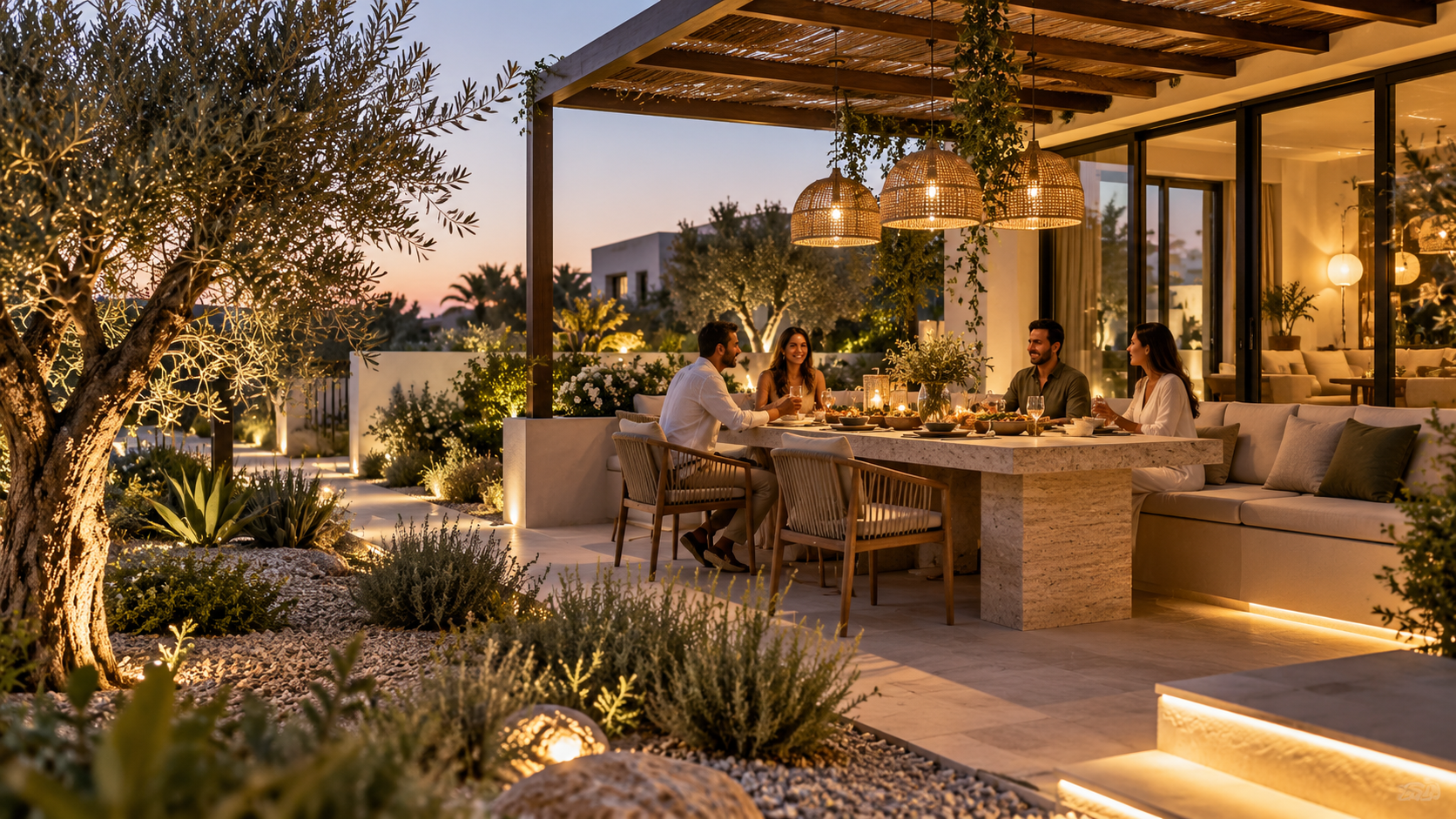
A garden design can include everything and still offer nowhere comfortable to sit. The dining table may be far from the kitchen, the best evening corner may be occupied by equipment, and a complicated planting scheme may demand more attention than the household can give it.
Start with the time you want to spend outside. A quiet morning, a family meal and a larger gathering need different arrangements, but they do not necessarily need separate permanent structures. The most useful brief connects those activities with the real site, the community's requirements and a maintenance plan you can sustain.
01Map the garden from the house outward
Begin at the doors you use most. Trace the route from the kitchen to a possible dining area, from the living room to a seat and from the entrance to any service access. Notice where carrying a tray, moving furniture or bringing gardening equipment would be awkward.
Record existing levels, drainage points, visible services and features that need professional assessment. Do not assume an apparently empty corner is available for excavation or a substantial structure. Ask the relevant professionals to establish what lies below and what access must remain.
Watch how sun, shade and wind affect the places you might use. If you are planning during only one season, acknowledge what you have not observed. A landscape professional can help assess the wider conditions. Keep the first sketch focused on activities and routes rather than filling every blank area with a feature.
02Give everyday use the best position
Decide which activity happens most often and give it a convenient location. A household that eats outside regularly may prioritise the route from the kitchen. Someone who mostly reads in the garden may prefer a quieter seat with a different outlook. An occasional party should not make the ordinary arrangement less comfortable.
Allow furniture to do some of the work. A flexible seating arrangement can be easier to adapt than several fixed zones, provided it is suitable, stable and manageable. Measure chairs in use and consider the space needed to pass around a table.
For children, pets or household members with particular access needs, include those requirements at the beginning and seek relevant professional advice. Do not add them as an afterthought once paths and planting beds have been fixed. The multigenerational home guide provides a useful starting point for a household conversation about shared and individual needs.
03Check permission before choosing permanent features
Confirm the community and authority requirements for the actual scope, including any structure, pool work, boundary change, external lighting or substantial alteration. If you rent, obtain the owner's agreement where needed and clarify responsibility for reinstatement and ongoing care.
Emaar's Arabian Ranches modification FAQ, for example, requires an NOC for a garden pergola and pool alterations. That is a named community's process; it should not be treated as a single rule covering every villa in the UAE. Ask the responsible management team which drawings and professional submissions apply to your proposal.
Keep approval and construction responsibility separate. Permission for a concept is not proof that every structural, electrical or drainage detail has been designed correctly. Appoint appropriately qualified professionals for the work and agree who coordinates the different parts. A contractor's willingness to start is not the same as confirmation that the project is ready.
04Choose planting with the site and water plan in mind
Ask the landscape designer or nursery to explain the suitability of proposed plants for the actual exposure, soil conditions, available space and care arrangements. Discuss mature size and access for maintenance. A plant that fits neatly into a rendering may need more room later.
Dubai Municipality's September 2026 announcement of its Greenery and Plantation Manual highlights water-efficient design, sustainable irrigation and native or adaptive species in public-realm planning. Those are useful themes to discuss with a professional, but the announcement is not a private-villa planting specification or a claim that one species suits every garden.
Request a coordinated irrigation and drainage plan appropriate to the property. Ask how zones will be maintained, how faults will be noticed and who will adjust the system when planting changes. Avoid choosing a watering schedule from a generic article; the plants, soil, season and installed system need to be considered together.
Swipe or use arrow keys to view all columns.
| Part of the garden | Decision to make | Evidence or responsibility |
|---|---|---|
| Seating and dining | Where will everyday use happen? | Measured layout and clear routes |
| Structures | What is permitted and suitable? | Approvals and professional design |
| Planting | What fits the site over time? | Species, mature size and care advice |
| Water management | How will irrigation and drainage work? | Coordinated design and maintenance plan |
| Long-term care | Who maintains each element? | Tasks, access and agreed costs |
05Budget for a garden you can keep
Ask for installation and ongoing care to be described separately. Identify tasks you will do yourself and tasks needing a service provider. Consider pruning, cleaning, equipment checks and replacement access without assuming every feature requires the same level of attention.
Discuss furniture and finish care before buying. A surface or accessory may be attractive but unsuitable for the time you are willing to spend maintaining it. The balcony makeover guide explores similar questions on a smaller scale, including storage and exposure.
Keep a record of materials, planting references, equipment models and relevant warranties. Ask how irrigation controls and other installed systems are operated, and have the responsible professional demonstrate them. A garden should not become difficult to manage because only the installer understands where a control is located or how to request a repair.
06Leave space to learn how you use it
A phased design can be sensible when the household is still discovering its preferences. Complete necessary professional groundwork properly, then consider whether every decorative feature needs to be purchased immediately. Use the seating area and notice where people naturally gather before adding more objects.
Review the garden at different times and after the first maintenance cycle. Does the route work when furniture is occupied? Is the preferred seat actually comfortable at the hour you use it? Are any features consistently ignored? Small adjustments may be more valuable than adding another focal point.
The best result is a garden that invites ordinary use and remains practical to care for. It can be restrained or expressive, but it should suit the household, respect the property's constraints and keep its promises on a normal evening as well as on the day it is photographed.
Sources
Research reviewed 30 October 2026. Publication dates and measurement periods are provided with each source.
- Emaar Arabian Ranches: home modification permissionsCommunity-specific FAQ checked 30 October 2026
- Dubai Municipality: Greenery and Plantation Manual 2026 announcement3 September 2026; public-realm planning scope, not a private-villa specification
Property costs, ownership and contract terms vary by home. Speak with Aliyas about the details relevant to your search.