
Interiors & upgrades • 5 min read
Lighting Design: Bringing Warmth and Character to Your UAE Home
Plan light around the way you read, cook, work and relax. Understand brightness and colour, test fittings in the room and compare controls before making permanent changes.
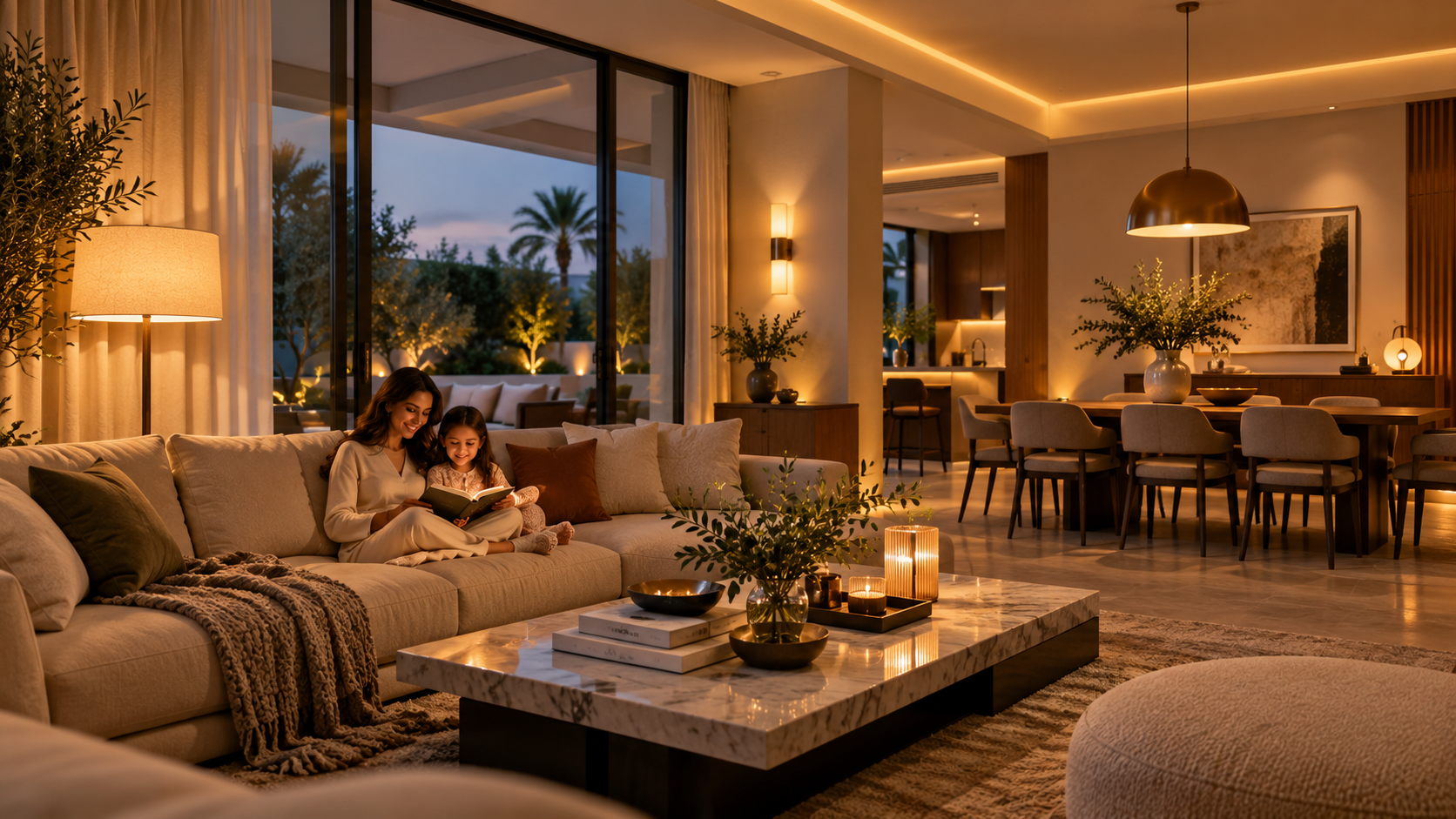
The room may not need more light everywhere. It may need light in the right place: on the book beside the sofa, across a kitchen preparation surface or around a mirror without an uncomfortable reflection. Turning on every ceiling fitting can leave those tasks poorly served while making the rest of the room feel harsh.
A useful lighting plan begins with activities and viewing positions. Decorative fittings come later. Start by noticing where the existing arrangement works, where you strain to see and which lights you avoid using. Those observations make a far better brief than asking for a brighter or more luxurious interior.
01Describe the evening before choosing the fittings
Walk through the home after sunset. Note the route from entrance to living room, where meals are prepared, where someone reads and how bedrooms are used before sleep. Include the positions of seated people, screens and reflective surfaces. A fitting looks different when you are looking up at it from a sofa rather than standing beneath it in a showroom.
Give each room a few named situations: cooking, eating, conversation, cleaning or working. Decide which lights should operate together and which should be independent. A single switch that activates every source may be convenient to install but unhelpful for those different activities.
The Australian and New Zealand Energy Rating guide distinguishes ambient lighting from task lighting. Use that distinction as a planning tool, not a requirement to fill every room with several types of decorative fixture. Sometimes a carefully placed reading light solves the problem without changing the ceiling at all.
02Read the specifications without confusing brightness and colour
The US Department of Energy's consumer lighting guide explains that lumens describe light output, while watts describe electrical power. It also distinguishes warmer-looking lower Kelvin values from cooler-looking higher values. These are product concepts, not a prescribed lighting scheme for UAE homes.
When replacing a lamp, record the fitting type and the existing product details. Compare the intended light output and appearance with what you want to change. Choosing a higher wattage without checking the fitting's requirements is not a design method. Ask a qualified supplier or electrician about suitability and compatibility.
Colour appearance also needs a real-room test. A warm wall finish can look different under two lamps, and mixing several colour appearances in one view may feel distracting. View samples with the furnishings you intend to keep. Avoid treating one Kelvin number as universally relaxing or suitable for every person and activity.
Swipe or use arrow keys to view all columns.
| Term or detail | What it helps you compare | What it does not establish alone |
|---|---|---|
| Lumens | Light output | Useful illumination at every surface |
| Watts | Electrical power | The colour or quality of the light |
| Kelvin value | Warm or cool appearance | How comfortable every person will feel |
| Colour rendering information | How colours are represented | The whole room's appearance |
| Dimmer compatibility | Supported control arrangement | Compatibility with every existing switch |
03Put the light where the task happens
For reading, test the position with the actual chair and book. For a desk, check the screen from the user's normal position and notice reflections. In a kitchen, consider whether a person standing at the counter blocks the light source. The aim is a useful working surface, not simply a bright patch on the floor.
Review glare from seated and standing positions. An exposed source that looks dramatic in a photograph may be uncomfortable in normal use. Ask the designer or supplier to demonstrate alternatives, including a different position, shade or beam distribution where appropriate.
Keep the arrangement coherent across adjoining rooms. A very bright corridor beside a softly lit living area can change the experience of both. The home-office layout guide considers lighting alongside screens, furniture and everyday work. Use specialist design advice where the requirements are more demanding than a straightforward replacement.
04Make controls and energy use part of the comparison
Decide how people will operate the lights without a phone or an explanation. A convenient wall control remains useful when visitors arrive or a device is unavailable. If smart controls are proposed, ask about manual operation, compatibility and support rather than assuming every connected product works together.
The Energy Rating guidance on dimmers notes that not every LED works with every dimming system. Confirm the exact combination with the supplier or electrician. Also ask whether a light source can be replaced separately or whether a failure requires replacing a larger fitting.
For an example energy calculation, imagine six lamps, each drawing 8 watts, used for five hours daily over thirty days. That is 6 × 8 × 5 × 30 ÷ 1,000 = 7.2 kWh. At three hours daily, the same sample arrangement uses 4.32 kWh. The difference is 2.88 kWh, not a promised bill saving. Actual products, use and tariffs will differ.
Example monthly lighting electricity
| Item | Value |
|---|---|
| Six 8 W lamps, five hours daily | 7.2 |
| Six 8 W lamps, three hours daily | 4.32 |
Unit: kWh over 30 days
05Try the scheme, then make permanent changes carefully
Where possible, test a proposed light source and position before ordering every fitting. View it during the activities that matter, with other lights on and off. Invite the people who use the room to comment; a setting that one person enjoys may be too dim or too intense for another.
Permanent electrical work, bathroom lighting and outdoor installations require suitable products and qualified professionals working within the applicable rules. Confirm building permissions for the scope. Do not improvise extensions or adapt a fitting beyond its instructions to achieve a particular appearance. The renovation planning guide helps coordinate these responsibilities with other work.
Keep product codes, control information and installation records. At handover, test each agreed scene and ordinary manual operation. Check that maintenance access remains available and that users understand the controls. A good lighting scheme should feel easy to live with: enough light where it is needed, a comfortable view of the room and no complicated ritual before sitting down to read.
Sources
Research reviewed 30 October 2026. Publication dates and measurement periods are provided with each source.
- US Department of Energy: consumer guide to energy-efficient lighting2021 technical consumer guide checked 30 October 2026; US household savings not applied to UAE
- Energy Rating: choosing the right lampAustralian/New Zealand guidance checked 30 October 2026; regulatory provisions not applied as UAE law
Property costs, ownership and contract terms vary by home. Speak with Aliyas about the details relevant to your search.