
Digital real estate • 5 min read
Property Listing Photos vs Virtual Tours: Getting a Fuller Picture
Use photographs for detail and a tour for spatial context, then check that both describe the same property. A stronger listing presentation should make unanswered questions easier to identify.
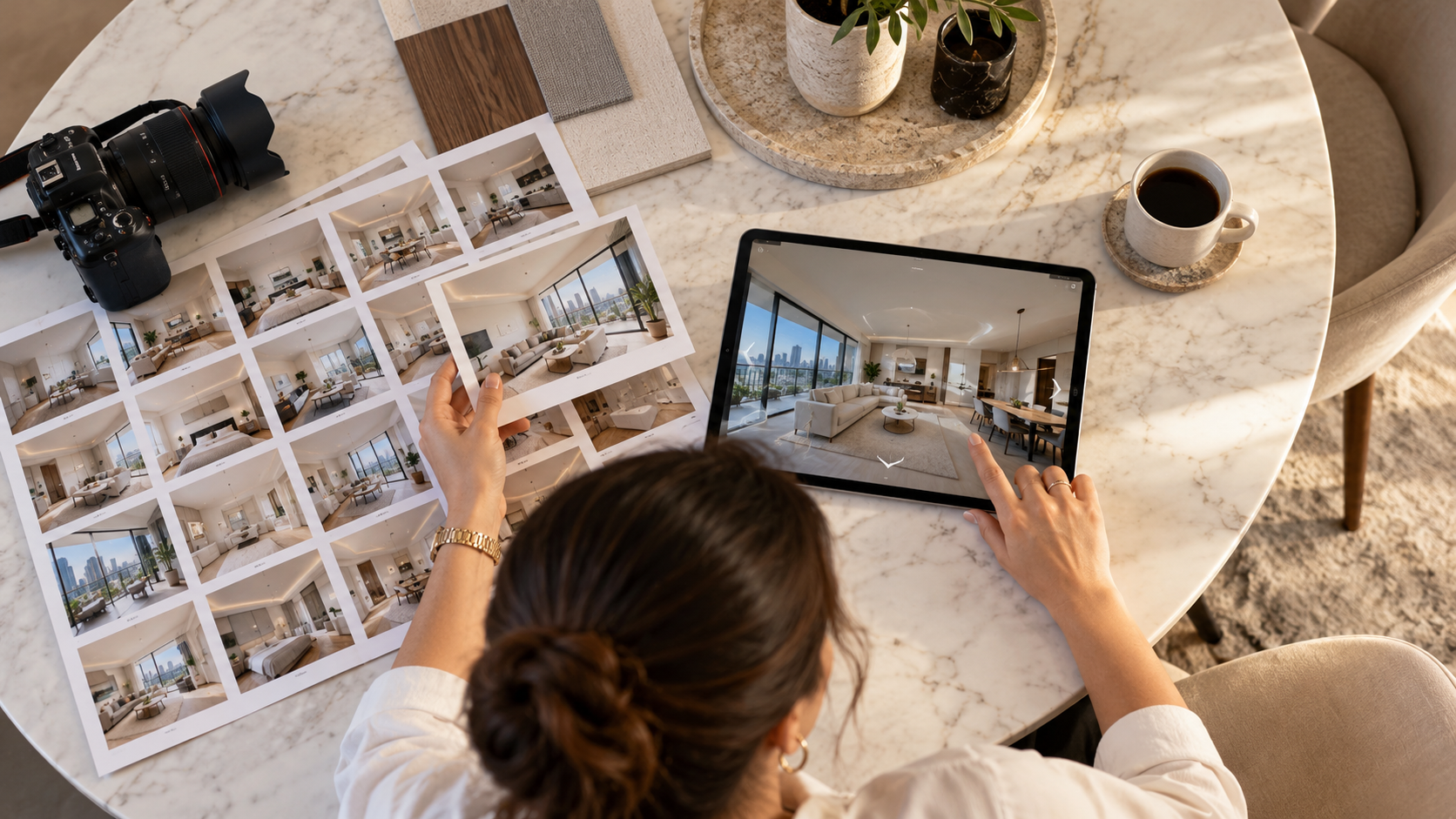
The photographs make the living room memorable. The tour helps you understand how you reach it. Neither format tells the whole story, and one should not be used to excuse gaps in the other. A useful property presentation gives you enough context to ask better questions before arranging a viewing.
Instead of deciding which format is superior, give each a job. Use photographs to inspect visible details, a plan or tour to understand relationships, and written information to establish identity and what is included. Then look for consistency across the set. Conflicting material is a reason to seek clarification, not to choose whichever image you prefer.
01Establish that every image belongs to the same story
Ask which images show the advertised unit and which show shared amenities, a show home or a sample design. For proposed property, identify renderings clearly and compare features with the relevant specification. A beautiful image of a similar layout is still not a photograph of the home you are evaluating.
Record capture dates where available and ask whether anything has changed since. Furniture, condition or the surrounding outlook may differ from an older presentation. A tour and a recent photograph can both be genuine while showing different stages.
Check property and advertisement details through the appropriate official route. Dubai Land Department's Madmoun explanation describes QR-based verification of authorised advertisement information. That check serves a different purpose from assessing the quality or current condition visible in pictures; do not treat one as proof of the other.
02Use photographs to slow down and notice details
Look beyond the widest room shot. Ask for useful views of storage, doors, kitchen work areas and any feature that affects your decision. A clear image can help you formulate a question about a visible mark or fitting, but it does not establish the cause or technical condition.
Compare several viewpoints of the same room. If you cannot understand the shape, ask for a labelled plan or another angle rather than inferring dimensions from the apparent size of furniture. Keep the actual dimensions of your own furniture available for later checks.
Pay attention to what is consistently missing. A presentation may show several attractive living-room angles and no utility area. That does not prove a problem, but it identifies an information gap. The digital floor-plan guide helps connect those gaps with the layout.
03Use the tour to understand connections
Follow the route from entrance to living areas, bedrooms and service spaces. Pause at transitions and look back towards the room you have left. This can make the relationship between spaces clearer than a collection of separate photographs.
Matterport's Showcase introduction describes navigation and overall spatial views in its platform. Where available, those tools can help you orient yourself, but the coverage and controls depend on how the tour was prepared. A missing viewpoint remains missing even if the rest of the capture is sophisticated.
Ask whether the tour is recorded, interactive or live. A recorded route cannot answer a new question; a live operator may be able to show another angle with permission. Neither format should be asked to replace an appropriate inspection of systems, concealed conditions or documents.
04Compare the evidence rather than counting the media
Create a small cross-check for the features that matter most. Does the plan match the route in the tour? Do the current photographs show the same finishes? Is the advertised storage visible? Ask for explanations where the material does not align.
Do not assume that more media means more certainty. A large number of photographs may repeat the same limited viewpoints. A smooth tour may omit the route from parking or a cupboard relevant to your needs. Judge completeness against your questions, not against the length of the presentation.
For a completed home, request current information where the decision depends on present condition. For an off-plan home, separate design intention from contractual commitments and current construction evidence. These are different kinds of information and should retain their labels throughout the search.
Swipe or use arrow keys to view all columns.
| Evidence | Useful for | Still needs checking |
|---|---|---|
| Current photographs | Visible finishes and selected details | Scale, coverage and unseen condition |
| Interactive or recorded tour | Relationships and routes | Capture date and missing areas |
| Live video call | Specific follow-up views | Connection and camera limitations |
| Floor plan | Layout and labelled dimensions | Purpose, version and accuracy |
| Official or contractual documents | Identity and stated commitments | Relevant professional interpretation |
05Ask for clarification in a way that can be answered
Replace a broad request for better pictures with a specific list. Ask for the entrance to the utility room, the wardrobe with its doors open or the view from the intended desk position. Explain why the detail matters so the person assisting can provide useful evidence.
Respect occupants' privacy and access restrictions. Photographs should not expose personal documents or private belongings unnecessarily. Obtain permission for recording and sharing, and keep the material within the purpose for which it was provided.
If a question cannot be answered remotely, mark it for the viewing. The virtual-tour guide suggests a structured way to do that. An honest limitation is more useful than a confident but unsupported answer designed to keep the presentation moving.
06Carry the comparison into the actual visit
Take the key images and plan references with you so you can identify the exact areas you wanted to inspect. Check whether the current home matches the presentation, and ask about differences before assuming they are minor. Record answers in writing where they affect the decision.
Use the visit for the experience the screen could not provide: movement through the rooms, the practical access route and the conditions you need to assess. Arrange qualified inspection where appropriate rather than treating your own viewing as a technical survey.
A strong presentation should make this visit more focused, not unnecessary. When photographs, tours and documents work together, they help you understand what attracts you to the property and what remains to be verified. That is a more useful result than being impressed by the media alone.
Sources
Research reviewed 30 October 2026. Publication dates and measurement periods are provided with each source.
- Dubai Land Department: Madmoun advertisement verificationOfficial service explanation checked 30 October 2026; no named advertisement verified
- Matterport Academy: Showcase navigation and spatial viewsProvider documentation checked 30 October 2026; actual tour coverage varies
Property costs, ownership and contract terms vary by home. Speak with Aliyas about the details relevant to your search.